Publications

FEATURED TOPICS

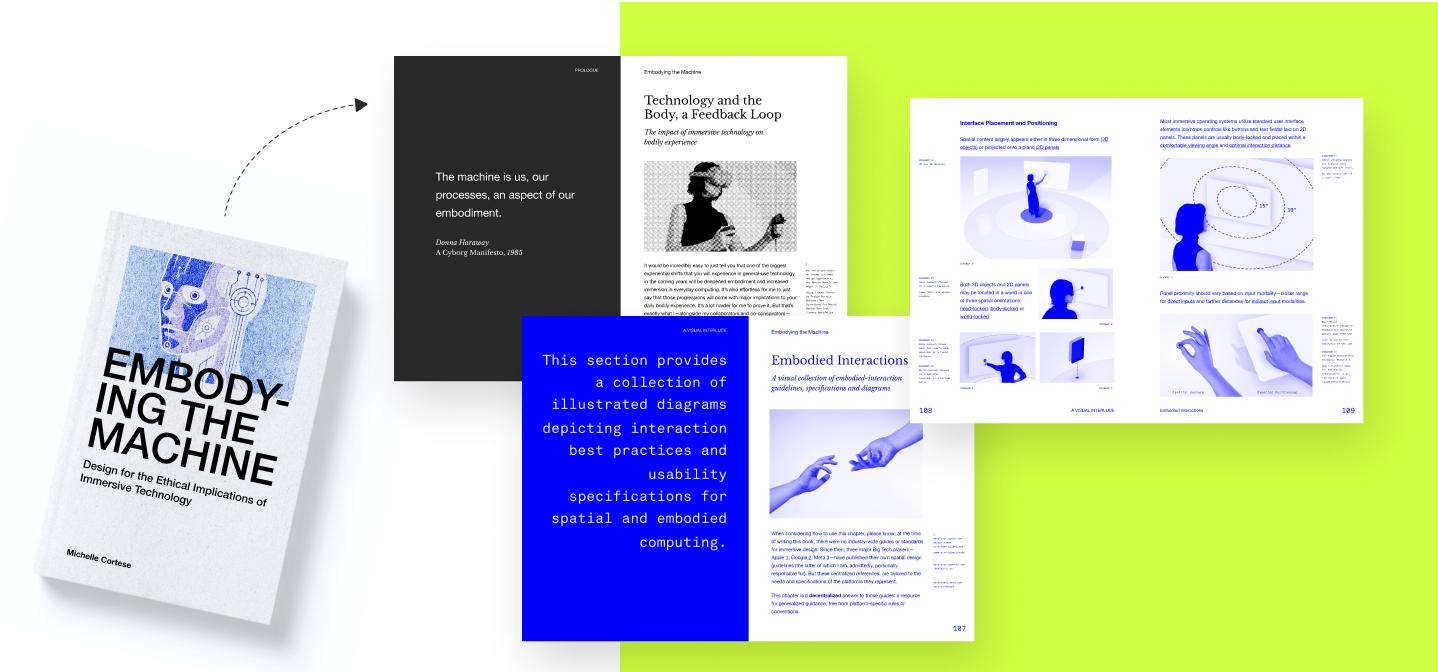
[ BOOK ]
My forthcoming book — to be published by Intellect Books in 2027 — is a synthesis of a decade-long design-research practice examining the ethical implications of spatial computing. The collection explores the experiential risks of increased embodiment in everyday technologies while introducing design strategies for harm-mitigation based on hedonomics, cybernetics and trauma psychology.

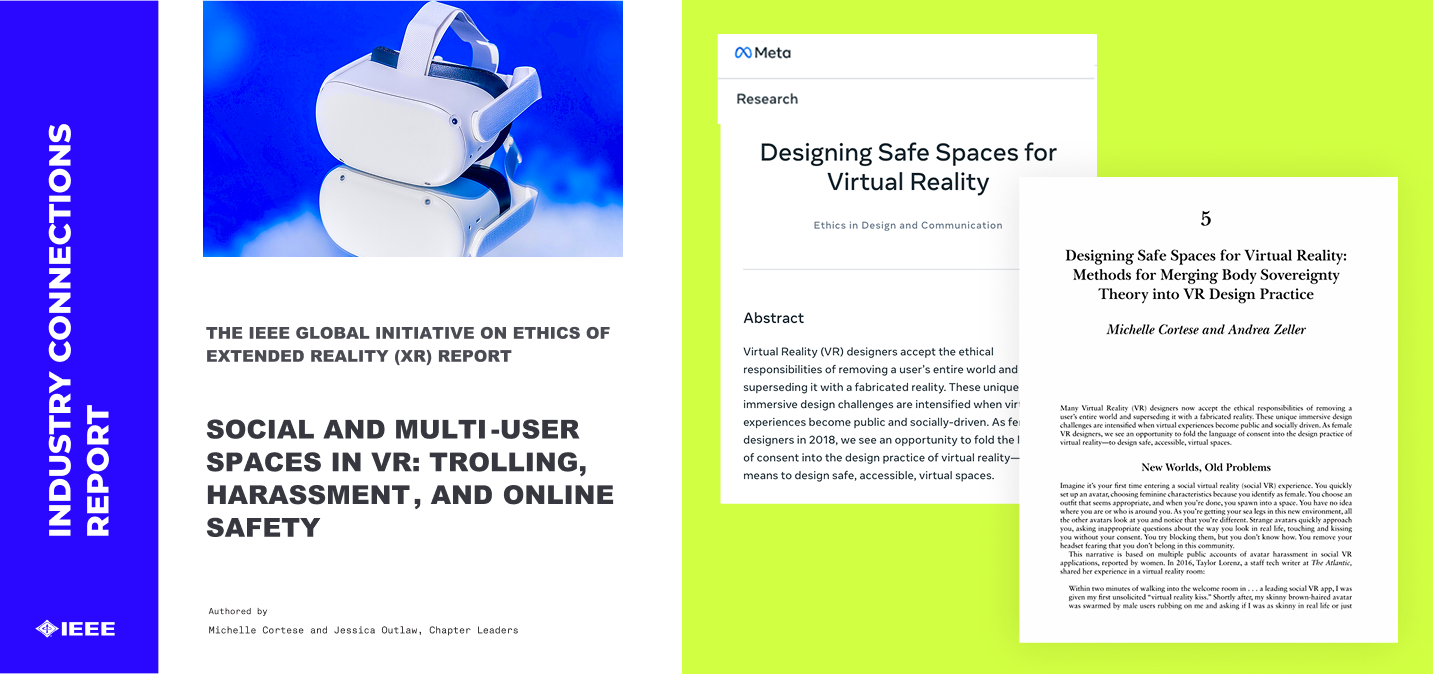
[ WHITE PAPER COLLECTION ]
“Designing Safe Spaces for Virtual Reality” represents a series of white papers, case studies and book chapters produced and published between 2018 and 2021. While all the publications in this series have a slightly different angle, they all unpack methods for applying proxemics, body sovereignty and consent ideology as a means to design and build safer and more accessible virtual spaces.
Published via: IEEE (2021), Design@Meta (2021), Bloomsbury (2020), Meta Research (2020), MIT Immerse (2019), etc.
Presented at: FITC (2019), Thinking Digital (2019), MIT Media Lab (2019), Firstmark NYC (2019), IxDC Beijing (2020), etc.


LIST VIEW
See all
-
Cortese, Michelle. Embodying the Machine: Design for the Ethical Implications of Immersive Technology. Bristol: Intellect Books, forthcoming 2027.
Cortese, Michelle & Zeller, Andrea. “Designing Safe Spaces for Virtual Reality.” In L. Scherling & A. DeRosa (Eds.), Ethics in Design and Communication: Critical Perspectives (pp. 49–60). London: Bloomsbury Visual Arts, 2020.
-
Cortese, Michelle & Outlaw, Jessica. “Social and Multi-User Spaces in VR: Trolling, Harassment, and Online Safety,” In The IEEE Global Initiative on Ethics of Extended Reality (XR) Report (pp. 1–17). IEEE Standards Association, 2021.
Cortese, Michelle & Zeller, Andrea. “Designing Safe Spaces for Virtual Reality: Methods for Merging Body Sovereignty Theory into VR Design Practice.” Meta Research, 2020.
-
Cortese, Michelle (ed). Meta Quest Human Interface Guidelines. Meta, 2024.
Cortese, Michelle & Zeller, Andrea. “A Blueprint for Designing Inclusive AR/VR Experiences.” Design at Meta, 2021.
Cortese, Michelle. “How Designers Can Build Experiences That Reduce Anxiety and Stress.” OneZero, 2020.
Cortese, Michelle & Zeller, Andrea. “Designing Safer Social VR.” MIT Immerse, 2019.
Research Context
Design Research Practice
I pursue design research at the intersection of embodied interaction, spatial computing and ethics. My work examines the experiential and ethical implications of embodied and immersive technologies, with a focus on developing frameworks that translate complex human-centered concerns into actionable design methodologies.
Ongoing Research Areas
Development of generalized interaction frameworks and guidelines for spatial computing.
Ethical design methodologies for consent, safety, and agency in multi-user virtual environments.
Translation of industry-scale design systems into pedagogical models for XR education.
Investigation of embodiment as a feedback system between human perception and computational environments.
New Research Areas
The Proxemics of Artificial Memory: Design frameworks for embodied AI and safer human-robot interaction.